

Hailstorms in Texas do not play around. One afternoon the sky is clear, and by evening, homeowners in Baytown are staring at dented gutters, bruised shingles, soaked insulation, and water spots crawling across ceilings. That is exactly why understanding the difference between a Public Adjuster vs. Insurance Adjuster for Hail Claims in Baytown, TX matters so much before a claim ever becomes disputed. Most homeowners assume the insurance process is straightforward. File the claim. Meet the adjuster. Get paid fairly. Replace the roof. Move on.
Sometimes that happens. Sometimes it absolutely does not. I have seen homeowners receive estimates missing major roofing components, incomplete interior repairs, code upgrades, and even entire sections of storm-related damage. The frustrating part? Many policyholders never realize what was overlooked until contractors begin tearing into the roof weeks later. That is where the distinction between an insurance adjuster and a public adjuster becomes incredibly important. One works for the insurance company. The other works for you. And when thousands of dollars are at stake after a Baytown hailstorm, that difference can shape the entire outcome of the claim.
Why Hail Damage Claims Are So Common in Baytown, TX
Texas weather creates the perfect environment for roofing claims. Baytown homeowners know this better than most. Strong Gulf moisture collides with unstable air masses. Temperatures shift rapidly. Wind speeds climb fast. Then hail starts falling. Sometimes the damage is obvious. Broken shingles. Bent vents. Torn flashing. Other times it hides quietly beneath the surface. That is what makes hail claims tricky.
A roof may appear fine from the ground while suffering severe granule loss, fractured matting, or compromised water-shedding capability above. Left unresolved, those issues can shorten the roof’s lifespan dramatically. Baytown properties also face another challenge: age. Many homes throughout the area have roofing systems already exposed to years of heat, humidity, UV degradation, and storm cycles. When hail hits an aging roof, insurance carriers sometimes argue the condition stems from wear and tear instead of storm damage. That instantly creates conflict. And conflict inside a hail claim often comes down to documentation, scoping, and interpretation.
What an Insurance Adjuster Actually Does
There is a major misunderstanding about insurance adjusters. Many homeowners assume they act as neutral third parties. They do not. Insurance adjusters represent the insurance carrier handling the claim. Their responsibility is to evaluate damage according to the policy terms and company guidelines.
That does not automatically make them dishonest. Many are experienced professionals working under intense pressure during catastrophe seasons. But their role is still tied directly to the insurer. After a Baytown hailstorm, insurance adjusters often handle dozens of inspections per week. In severe storm seasons, that workload can become overwhelming.
Here is what a typical insurance adjuster inspection may involve:
| Inspection Area | Typical Focus |
| Roof slopes | Visible hail impacts |
| Gutters/downspouts | Denting evidence |
| Soft metals | Functional impact indicators |
| Interior ceilings | Water intrusion signs |
| Exterior elevations | Collateral damage |
The challenge is time.
Some inspections move quickly. Very quickly.
A rushed inspection can miss:
- Underlayment damage
- Ventilation issues
- Detached flashing
- Moisture intrusion
- Code-required upgrades
- Hidden decking problems
- Interior insulation saturation
This becomes especially important when the initial estimate forms the foundation of the claim payment. If the scope starts incomplete, the entire claim can begin from a disadvantaged position.
Why Insurance Estimates Often Come in Lower Than Expected
Homeowners are frequently shocked after receiving their first estimate. The number feels low. Sometimes extremely low. There are several reasons this happens.
Scope Omissions
Not every roofing component automatically appears in an estimate. Items like drip edge, starter shingles, ridge cap, flashing replacement, or ventilation upgrades may be partially included or omitted entirely. That adds up fast.
Depreciation
Many policies calculate actual cash value initially before releasing recoverable depreciation later. Homeowners unfamiliar with policy structure often mistake this as a denial of payment.
Pricing Databases
Insurance estimates commonly rely on regional pricing databases through estimating platforms like Xactimate. If labor pricing or material costs have recently shifted, contractors may disagree with the estimate totals.
Coverage Interpretation
Insurance carriers and contractors may interpret policy language differently regarding matching, code upgrades, or repairability. That is where disputes begin. And that is often where homeowners start looking into the debate surrounding Public Adjuster vs. Insurance Adjuster for Hail Claims in Baytown, TX.
What a Public Adjuster Does During a Hail Claim

A public adjuster represents the policyholder, not the insurance company. That changes the dynamic immediately. Instead of focusing on limiting exposure for the carrier, the public adjuster focuses on fully documenting and supporting the homeowner’s loss within the policy terms.
A strong public adjuster does far more than simply argue for a higher payment. They investigate. They document. They organize evidence. They build a detailed claim presentation. And most importantly, they understand how insurance language and estimating systems work together.
Detailed Documentation Changes Everything
Public adjusters often spend significantly more time evaluating the loss.
That may include:
- Roof inspections
- Moisture readings
- Interior damage mapping
- Attic inspections
- Photo documentation
- Drone imagery
- Material identification
- Code compliance analysis
The goal is simple: develop a complete picture of the damage. That matters because insurance companies pay based on evidence. Not frustration. Not assumptions. Evidence.
Policy Interpretation Is a Huge Part of the Process
Most homeowners have never fully read their policy until after a hailstorm. Even then, the language can feel overwhelming.
Terms like these create confusion quickly:
- Replacement Cost Value (RCV)
- Actual Cash Value (ACV)
- Ordinance and Law Coverage
- Matching exclusions
- Cosmetic damage exclusions
- Deductible application
- Depreciation schedules
Public adjusters spend substantial time interpreting how those provisions apply to the loss. That becomes especially important in Baytown hail claims involving older roofing systems or disputed repairability.
The Biggest Differences Between Public Adjusters and Insurance Adjusters
The debate surrounding Public Adjuster vs. Insurance Adjuster for Hail Claims in Baytown, TX really comes down to representation. Here is the clearest breakdown.
| Public Adjuster | Insurance Adjuster |
| Represents homeowner | Represents insurance company |
| Advocates for policyholder | Evaluates claim for carrier |
| Performs independent scope review | Follows carrier claim process |
| Negotiates for full covered damages | Determines carrier payment position |
| Often works on contingency fee | Paid by insurer |
That difference affects everything. Communication style. Inspection depth. Negotiation approach. Claim strategy. Even the language used during inspections can differ dramatically.
Why Hail Claims Become Disputed in Baytown
Baytown homeowners often assume hail claims only become disputed when carriers deny coverage completely. That is not true. Many disputes involve partial approvals. The insurance company may agree hail occurred while disagreeing about the scope of necessary repairs. That distinction matters.
Cosmetic vs. Functional Damage
One of the biggest battlegrounds involves whether damage affects roof performance. Carriers may classify impacts as cosmetic. Contractors or public adjusters may argue the impacts compromise long-term functionality.
This commonly involves:
- Metal roof denting
- Granule displacement
- Shingle bruising
- Membrane punctures
- Surface fractures
The difference between cosmetic and functional classification can dramatically change payout amounts.
Matching Problems
Partial roof repairs create another headache. Imagine replacing only one slope of a weathered roof. Now the home has mismatched shingles with visible color variation. Some homeowners accept it reluctantly. Others challenge whether the repair restores the property to pre-loss condition. That debate appears regularly in Texas hail claims.
Underpaid Roofing Components Add Up Fast
One missing line item might seem minor. Ten missing line items are not.
Public adjusters frequently review estimates containing omissions involving:
- Ice and water shield
- Starter shingles
- Ridge ventilation
- Flashing replacement
- Steep charges
- High charges
- Drip edge
- Permit fees
- Detach and reset items
Individually, these may appear small. Collectively, they can create thousands of dollars in scope differences. That is one reason the phrase Public Adjuster vs. Insurance Adjuster for Hail Claims in Baytown, TX continues gaining attention among homeowners facing underpaid claims.
Understanding Xactimate and Why It Matters
Xactimate dominates the insurance estimating world. It is the primary software platform used for property claim estimates throughout the industry. Every line item carries pricing tied to labor, materials, equipment, and regional cost databases. A proper Xactimate estimate is not simply a roofing bid pasted into software. It requires detailed scoping knowledge.
Measurements matter. Waste calculations matter. Code requirements matter. Material matching matters. And line-item selection matters enormously. A missing code upgrade alone can create substantial pricing differences.
Common Xactimate Problems in Hail Claims
Public adjusters often identify issues like:
- Incorrect roof measurements
- Missing detach/reset operations
- Incomplete flashing replacement
- Underestimated labor charges
- Omitted ventilation requirements
- Inaccurate material classifications
That is why supplement requests are common after roofing contractors begin work. Supplements exist because hidden or omitted damage frequently emerges after the initial inspection.
Why Supplements Are So Important
Supplements are not scams. They are corrections or additions to claim scope based on newly identified information.
That may involve:
- Decking rot discovered during tear-off
- Additional code requirements
- Material discontinuation
- Hidden flashing damage
- Structural concerns
- Ventilation deficiencies
Without supplements, homeowners may end up absorbing costs that should have been evaluated within the claim.
Accurate documentation becomes even more important when supplement negotiations begin. In many Baytown roofing claims, additional damage only becomes visible after shingles are removed and contractors access the underlying system components. This is why the topic of “Hail Damage Claim Supplements: What Carriers Miss in Their Scope” has become increasingly important for Texas homeowners trying to avoid incomplete repairs after severe storms. Missing flashing components, ventilation upgrades, detached accessories, and hidden decking deterioration can dramatically affect the true cost of restoration. Much like the layered complexity found in Topology, hail claims often involve interconnected problems that are not immediately visible during an initial inspection. The more thoroughly the property is evaluated, the more accurate the final claim outcome usually becomes.
When Baytown Homeowners Should Consider Hiring a Public Adjuster
Not every claim requires a public adjuster. Some hail claims resolve smoothly. Others absolutely do not. Here are situations where homeowners often seek professional representation.
Denied Claims
A denial letter does not always mean the damage is nonexistent.
It may involve disagreements surrounding:
- Storm causation
- Wear and tear
- Prior damage
- Repairability
- Policy exclusions
Public adjusters often reopen documentation discussions after denials.
Underpaid Claims
One of the clearest warning signs involves contractor estimates drastically exceeding insurance scope. That gap deserves investigation.
Large or Complex Losses
The more complicated the claim becomes, the more documentation matters.
Especially when the property includes:
- Multiple structures
- Commercial roofing systems
- Interior water damage
- Solar equipment
- Detached garages
- Custom materials
Lack of Time
Managing a hail claim takes work. Phone calls. Inspections. Emails. Photos. Contractor coordination. Supplement discussions. Reinspection scheduling. Many homeowners simply do not have time to manage the process alone.
Situations Where Both Adjusters May Agree
Not every claim becomes adversarial. In fact, some hail claims are straightforward. Severe catastrophic damage often produces quick agreement because the evidence is undeniable.
Examples include:
- Massive shingle displacement
- Punctured roofing systems
- Broken skylights
- Severe collateral metal damage
- Active water intrusion
Strong documentation also helps both sides reach agreement faster. That is why immediate post-storm evidence collection matters so much.
Common Misconceptions About Public Adjusters
There are plenty of myths surrounding public adjusters. Let’s clear up a few.
“Hiring a Public Adjuster Means Going to Court”
No. Most claims settle through negotiation and documentation long before litigation enters the conversation.
“Insurance Companies Always Pay Fairly the First Time”
Sometimes they do. Sometimes they miss things. Large catastrophe workloads increase the chances of oversight.
“Only Massive Claims Need Representation”
Moderate residential claims can also involve significant underpayments or scope disputes.
“The Insurance Adjuster Is Neutral”
Again, the insurance adjuster represents the carrier. That is not inherently bad. But homeowners should clearly understand the role.
Questions Homeowners Should Ask During a Hail Claim
The right questions can completely change how a claim develops.
Questions for Insurance Adjusters
- What damages were excluded from the estimate?
- How was depreciation calculated?
- Are code upgrades included?
- Was the attic inspected?
- Were all roofing accessories evaluated?
- What caused the denial of specific items?
Questions for Public Adjusters
- Are you licensed in Texas?
- How much hail claim experience do you have?
- Do you write Xactimate estimates?
- Have you handled Baytown claims before?
- How do you manage supplements?
Those conversations matter more than homeowners realize.
Why Local Experience Matters in Baytown
Texas hail claims are not identical to claims in other states. Regional weather patterns matter. Roofing styles matter. Carrier behavior in Texas catastrophe markets matters.
A professional familiar with Baytown roofing systems understands local challenges involving:
- Coastal humidity
- Wind-driven rain
- Older shingle systems
- Heat deterioration
- Storm frequency
That local context can shape claim strategy significantly.
Protecting Your Property Immediately After a Hailstorm
The first 48 hours after a storm are critical. Homeowners should move quickly.
Immediate Steps to Take
- Photograph all visible damage
- Document hail size if possible
- Prevent additional water intrusion
- Save damaged materials
- Keep receipts for emergency mitigation
- Schedule professional inspections
Simple documentation decisions early in the process can become extremely important months later.
Common Mistakes Homeowners Make During Hail Claims
Unfortunately, many claim problems begin with preventable mistakes.
Waiting Too Long
Evidence fades.
Leaks spread.
Storm history becomes harder to verify.
Assuming the First Estimate Is Final
Initial estimates frequently change after supplements and contractor review.
Throwing Away Damaged Materials
Preserving physical evidence can strengthen disputed claims significantly.
Ignoring Interior Moisture
Roof damage does not stop at shingles.
Attics, insulation, drywall, and framing may also suffer hidden damage.
The Emotional Side of Hail Claims
This part rarely gets discussed enough. Storm claims are exhausting. Homeowners are balancing family responsibilities, work schedules, contractor meetings, insurance calls, and financial uncertainty all at once. That stress builds quickly. Especially when communication slows or claim disputes drag on for months. A roof claim is not just paperwork. It is someone’s home. Someone’s largest investment. Someone’s financial stability. That human side matters.
How the Hail Claim Process Usually Unfolds in Baytown, TX
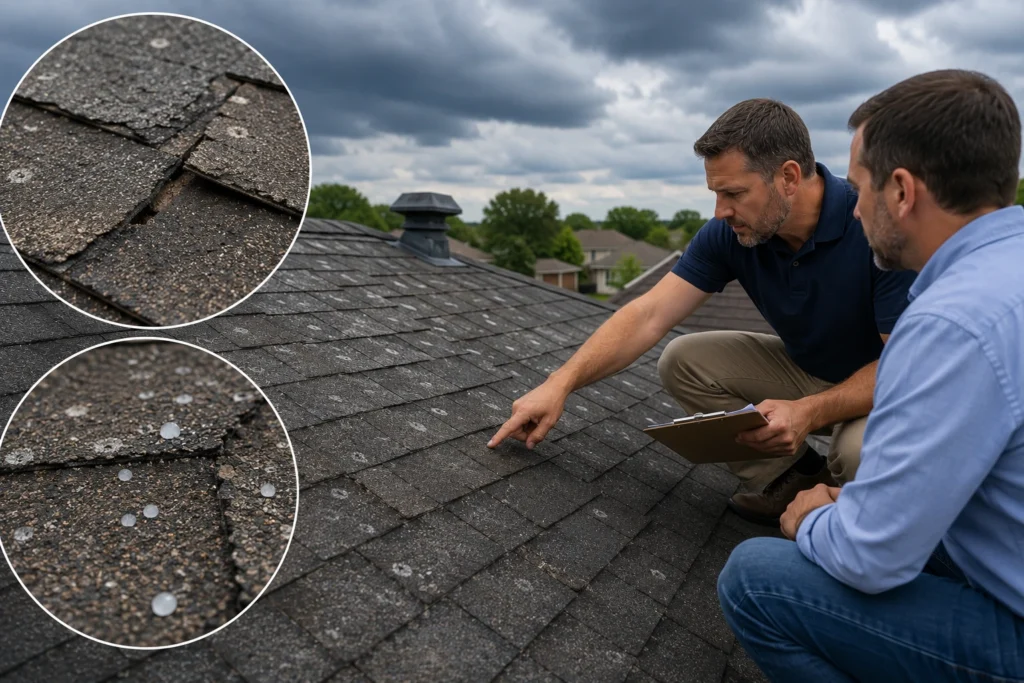
Many homeowners feel overwhelmed simply because they do not know what comes next. The hail claim process can move quickly at first, then suddenly slow down for weeks. Understanding the normal flow helps reduce confusion and allows homeowners to spot problems early. The process usually begins with storm discovery. A homeowner notices roof debris, dented gutters, ceiling stains, or contractor door-knocking after a severe Baytown hailstorm. The claim gets reported to the insurance carrier, and an inspection is scheduled. That sounds simple enough.
But this is where the paths between a public adjuster and insurance adjuster often begin separating. An insurance adjuster typically performs the carrier inspection first. They evaluate visible damages, photograph affected areas, and prepare an estimate using industry software. Depending on the severity of the storm season, inspections may last anywhere from under an hour to several hours.
Afterward, the carrier issues one of several outcomes:
- Full approval
- Partial approval
- Request for additional information
- Denial
- Reservation of rights letter
Homeowners are often surprised when contractors reviewing the estimate identify missing items almost immediately. That is extremely common in hail claims. Roofing systems are layered assemblies. Damage is not always visible during a quick surface inspection. Once contractors begin removing shingles, additional issues often emerge involving flashing, decking, underlayment, or ventilation systems.
This is where supplements enter the picture again. A public adjuster usually becomes heavily involved during this phase by organizing additional documentation, reviewing contractor findings, updating Xactimate line items, and negotiating revised scope adjustments with the insurance company. Without someone actively monitoring the process, homeowners sometimes assume denied items are final when they may actually remain negotiable. That misunderstanding costs policyholders money every year.
How Roof Age Impacts Hail Claims in Texas
Roof age changes everything during a hail claim. An older roof naturally experiences wear over time. Granule loss, thermal cracking, sealant deterioration, and material fatigue occur even without storms. Insurance carriers know this, and they frequently use roof age as part of claim evaluations. Here is the problem. A roof can have legitimate age-related wear while also suffering new hail damage at the same time. Those two conditions are not mutually exclusive.
This creates one of the most contested areas in the entire discussion surrounding Public Adjuster vs. Insurance Adjuster for Hail Claims in Baytown, TX. Insurance adjusters may argue certain conditions predated the storm. Public adjusters or contractors may argue the hail event accelerated failure or created functional compromise requiring replacement.
This becomes especially important with asphalt shingles. Hail impacts can fracture the shingle mat beneath the visible surface. To an untrained eye, the roof may appear repairable. Months later, however, the damaged area may deteriorate rapidly under Texas heat and moisture exposure.
That is why proper inspection methodology matters so much. Some professionals perform soft-metal testing, brittle testing, moisture analysis, and detailed slope-by-slope evaluation instead of relying solely on surface observation. The difference in inspection depth can dramatically affect the final claim outcome.
Why Communication Problems Derail So Many Claims
One overlooked issue in hail claims is communication breakdown. Not fraud. Not policy language. Communication.
Homeowners often speak with:
- Field adjusters
- Desk adjusters
- Roofing contractors
- Claims supervisors
- Mitigation companies
- Engineers
- Public adjusters
Every party uses slightly different terminology and priorities.
That creates confusion fast.
For example, a homeowner may hear:
“We approved the roof.”
But what does that actually mean?
Approved for repair?
Approved for replacement?
Approved only for one slope?
Approved excluding code upgrades?
Approved minus depreciation?
Those details matter enormously. Public adjusters often help bridge communication gaps by translating technical claim language into practical explanations homeowners can actually understand. That alone can reduce stress during complex Baytown hail claims. Because confusion leads to mistakes. And mistakes during insurance claims become expensive very quickly.
The Importance of Independent Roof Inspections
One inspection should never automatically end the conversation after a major hailstorm. That does not mean every insurance adjuster misses damage. Many are highly experienced. But independent inspections provide another layer of verification that protects homeowners from incomplete evaluations.
An independent roofing inspection may identify:
- Lifted shingles
- Hidden punctures
- Creased tabs
- Detached flashing
- Saturated decking
- Improper prior repairs
- Ventilation deficiencies
- Storm-created water pathways
Those findings may completely reshape the scope of the claim. This is another major reason homeowners researching Public Adjuster vs. Insurance Adjuster for Hail Claims in Baytown, TX often seek second opinions before finalizing repairs. The cost difference between a partial repair and a full roofing system replacement can be massive. And once repairs begin incorrectly, reversing the process becomes much harder.
Why Baytown Homeowners Need to Think Long-Term
One of the biggest mistakes homeowners make after hailstorms is focusing only on immediate payment amounts. The real issue is long-term property protection. A poorly scoped repair today can create major expenses years later.
Imagine this scenario. A roof receives partial repairs after hail damage. Several components remain unreplaced because they were omitted from the estimate. Months later, ventilation imbalance creates moisture buildup in the attic. Decking deterioration begins quietly. Eventually leaks appear around flashing systems that should have been replaced during the original repair. Now the homeowner faces another battle.
And this time the insurance carrier may argue the problems stem from improper repairs or maintenance instead of storm damage. That situation happens more often than people realize. The best hail claim outcomes are not simply the largest payouts. They are the most complete and accurate repairs. That is the real goal. Homeowners in Baytown should approach storm claims strategically, patiently, and with strong documentation from the very beginning. Because once the contractors leave and the claim closes, the long-term condition of the property becomes the homeowner’s responsibility again.
The Long-Term Financial Impact of Underpaid Hail Claims
Some homeowners accept low settlements simply because they want the process over. That can become expensive later.
An underfunded roof replacement may lead to:
- Delayed repairs
- Continued leaks
- Mold development
- Structural deterioration
- Reduced resale value
- Insurance underwriting issues
The true cost of an incomplete claim sometimes appears years after the storm itself. That is why the conversation surrounding Public Adjuster vs. Insurance Adjuster for Hail Claims in Baytown, TX has become increasingly important for Texas homeowners trying to protect long-term property value.
Why Documentation Wins Claims
The strongest claims are usually the best-documented claims. Not the loudest. Not the angriest. The most organized.
Strong claim documentation often includes:
- Date-stamped photos
- Roof inspection reports
- Moisture readings
- Contractor scopes
- Repair invoices
- Weather data
- Interior damage mapping
Clear evidence removes ambiguity. And ambiguity is where disputes grow.
Final Thoughts on Public Adjuster vs. Insurance Adjuster for Hail Claims in Baytown, TX
The difference between a public adjuster and an insurance adjuster is ultimately about representation. One works for the insurance company. One works for the policyholder. That distinction affects inspections, negotiations, documentation, scope development, and claim strategy from beginning to end.
For Baytown homeowners dealing with hail damage, understanding those roles can prevent costly mistakes during one of the most stressful parts of property ownership. Not every claim requires professional representation. But every homeowner should understand their options before accepting a settlement, approving repairs, or walking away from disputed damage. Because once the storm passes, the real challenge often begins. And in the world of Public Adjuster vs. Insurance Adjuster for Hail Claims in Baytown, TX, knowledge is not just helpful. It is financial protection.
FAQs
A public adjuster represents the homeowner, while an insurance adjuster represents the insurance company handling the claim.
It depends on the complexity of the claim, especially if the damage is underpaid, disputed, or denied.
Yes. Fast inspections, hidden roof damage, and heavy storm workloads can sometimes lead to incomplete estimates.
A public adjuster documents damage, reviews policy coverage, prepares estimates, and negotiates with the insurance carrier.
Additional damage is often discovered after roofing materials are removed during repairs.
No. Most public adjusters work through negotiation and claim documentation rather than litigation.
Xactimate is industry-standard estimating software used to calculate repair and replacement costs.
Simple claims may resolve in weeks, while disputed or supplement-heavy claims can take several months.
Take photos, prevent further damage, save receipts, and schedule a professional roof inspection quickly.
Yes. Insurance companies may argue older roofs have wear-related issues instead of storm-related damage.